
🔄 Ikea: Designed for adaptive potential
The Waste Trilogy part two: Case study #6

This case study is the sixth of a series of seven, published in conjunction with The Waste Trilogy - Part Two: waste potential.
A quick recap of the methodology for context …
Overall objective: Identify efforts that tap rather than waste potential, using human imagination, creativity, and collective action.
Diagnostic framework: How do these efforts succeed in improving conditions for human thriving via (1) lightening our metabolic load (reduce our metabolic 'waste'), (2) expanding our metabolic capacity (improve our 'waste' management), and (3) reorienting our metabolism (change our 'diet')?
Domains of 'waste': Environmental, economic, social, human.
Now let’s dive in!

Scroll to read and play this song, if you are so inclined …
🔄 Designed for adaptive potential
“We need to zoom out and not only look at the business itself, but put IKEA in the context of the big planet.” — IKEA employee
IKEA’s journey towards a fully circular business model by 2030 represents an encouraging shift in the global retail landscape. Recognizing the escalating environmental impact of its operations and the growing consumer demand for sustainability, IKEA embarked on this ambitious transformation in the early 2010s. This initiative was driven by a company-wide mandate from senior management and was fuelled by feedback from employees, customers, and sustainability experts, creating a holistic and inclusive approach.
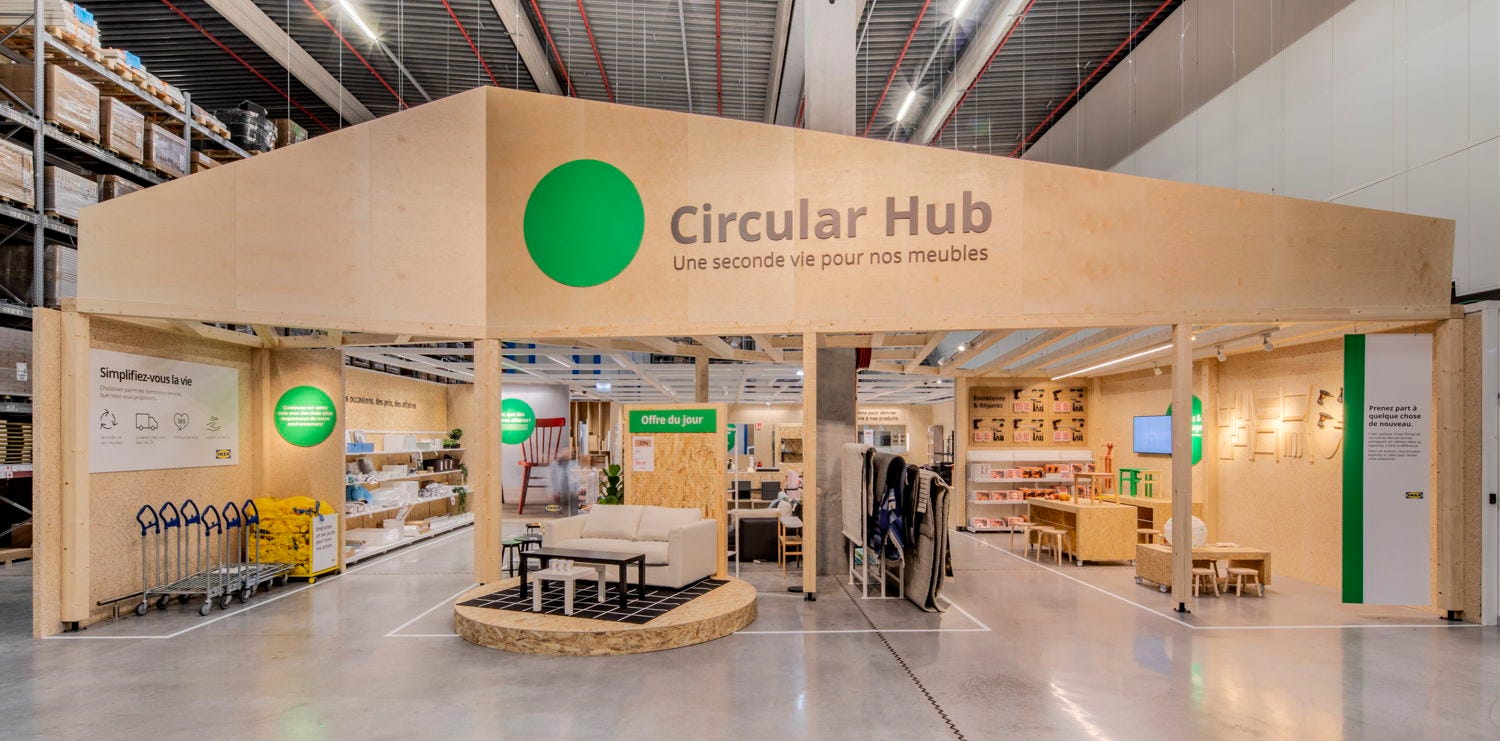
The core of IKEA’s circular strategy lies in designing products that can be reused, repaired, and recycled. This effort is supported by the establishment of Circular Hubs in IKEA stores worldwide, where customers can return used furniture for refurbishment and resale, promoting a culture of reuse and significantly reducing waste. The Circular Hub in Eskilstuna, Sweden, is a notable example, reselling pre-loved items, ex-display products, and items with minor defects at discounted prices.
IKEA also promotes healthy and sustainable living through initiatives like affordable home solar solutions and the IKEA Better Living App, which provides practical tips for reducing waste and energy consumption. Additionally, IKEA’s climate agenda aims for the company to become climate positive by 2030, involving significant investments in renewable energy. And the company’s commitment to regenerating resources is evident in its sustainable sourcing practices, ensuring materials such as wood and cotton come from more sustainable sources.
“Circularity holds a central position for us, encompassing not only products and services but also waste management, where our aim is zero waste. It’s definitely our priority.” — IKEA employee
But the transformation to a circular business model has not only reduced IKEA’s environmental footprint but also spurred creativity and commitment within its workforce. Projects like ThisAbles, which provides 3D-printed add-ons to make furniture accessible for people with disabilities, originated in Israel before expanding to other countries and is an example for IKEA’s commitment to inclusivity and sustainable growth. The IWAY standard, IKEA’s supplier code of conduct, is another example, ensuring fair labor practices and environmental standards throughout its supply chain, improving working conditions for thousands of workers globally.
“There are many projects that revolve around working with waste material and developing new material to challenge the status quo and to address the challenges we face (…) towards our common goal of being circular by 2030.” — IKEA employee
The impact of IKEA’s circular initiatives has been significant and multifaceted:
Recycling and Waste Reduction: IKEA has made substantial progress in reducing waste through its Circular Hubs. Millions of products have been returned, refurbished, and resold, leading to a significant decrease in items ending up in landfills. In 2022 alone, IKEA managed to refurbish over 47 million pieces of furniture, contributing to a 30% reduction in waste compared to 2017 levels.
Economic Savings: The introduction of Circular Hubs and the sale of refurbished products have not only provided affordable options for consumers but also created new revenue streams for IKEA. The company's commitment to renewable energy has further enhanced its economic resilience, reducing operational costs by 25% due to energy efficiency measures.
Customer Empowerment and Inclusivity: Projects like ThisAbles have empowered individuals with disabilities by allowing them to customize their furniture, enhancing their quality of life. The initiative has also raised awareness about inclusivity and accessibility, with over 13,000 ThisAbles add-ons distributed globally.
Environmental Sustainability: IKEA’s use of renewable and recycled materials has reduced its environmental footprint. The company’s commitment to sourcing 100% renewable energy and reducing greenhouse gas emissions across its supply chain has led to a 15% decrease in overall carbon emissions since 2017.
Community Engagement: IKEA’s circular model has fostered a sense of community among customers. Educational campaigns and community engagement activities have promoted sustainable consumer habits and a shared commitment to environmental responsibility, involving over 2 million participants in sustainability workshops and events.
To get a more vivid sense of Ikea’s push for circularity by 2030 watch this four minute video.
Reshaping the metabolism of Ikea
Now let’s deconstruct Ikea’s transformation of wasted potential into a circular ecosystem that balances corporate growth with the needs of human beings and the environment. What strategies and actions are helping Ikea reshape their metabolism? How are these actions lightening the load, expanding capacity and redirecting its corporate metabolism?
Lighten the load
🧑🤝🧑 Human — Improved sustainable practices and the availability of affordable refurbished furniture reduce financial stress and promote mental well-being.
🤝 Social — Initiatives like ThisAbles promote inclusivity, allowing people with disabilities to customize furniture according to their needs, improving their quality of life.
💰 Economic — By offering refurbished products, IKEA provides affordable options for customers, reducing the financial burden of purchasing new furniture.
🌍 Environmental — IKEA’s use of renewable and recycled materials reduces the need for virgin resources, minimizing environmental impact. The Circular Hubs divert used furniture from landfills, significantly reducing waste.
Expand Capacity
🧑🤝🧑 Human — Initiatives like ThisAbles empower individuals by providing tools to adapt their living spaces to their specific needs, enhancing their sense of agency and satisfaction.
🤝 Social — The Circular Hubs foster a sense of community by encouraging customers to return and refurbish their furniture, creating a shared commitment to sustainability.
💰 Economic — The Circular Hubs create new revenue streams for IKEA through the sale of refurbished products and recycling services, boosting the company’s economic resilience.
🌍 Environmental — Modular design principles ensure that furniture can be easily customized, repaired, and extended, prolonging the lifecycle of products and reducing the need for new purchases.
Redirect Metabolism
🧑🤝🧑 Human — Hands-on participation in refurbishing and customizing furniture fosters creativity and a sense of accomplishment, contributing to overall well-being.
🤝 Social — Educational campaigns and community engagement activities raise awareness about the importance of circular practices, fostering a culture of sustainability and social responsibility.
💰 Economic — IKEA’s commitment to renewable energy and sustainable practices enhances its brand value and customer loyalty, driving long-term economic benefits.
🌍 Environmental — By establishing Circular Hubs and promoting a culture of reuse, IKEA shifts consumer behavior towards sustainable practices, reducing the overall environmental footprint.
“Becoming circular means that we redefine pretty much everything. What we produce, how we produce it and also how we interact with our customers.” — IKEA employee
IKEA’s circular business model exemplifies how the company is transforming potential into sustainable growth and human thriving. By embracing modular design, renewable energy, and inclusive practices, IKEA is redefining its metabolism to improve conditions for environmental, economic, social, and human well-being. While the high volume of products sold by IKEA still contributes to resource use and waste, the significant progress in reducing its environmental footprint and promoting sustainable practices is noteworthy. Critics might argue that the scale of IKEA's operations poses ongoing challenges, but the company’s innovative strategies and commitment to a circular economy demonstrate significant progress and provide valuable insights for the future. IKEA's journey highlights the importance of continuous improvement, community engagement, and the potential for large-scale impact through sustainable business practices.
###
Sources and links for further reading
IKEA Annual and Sustainability Report 2023
Sustainability by Design: IKEA’s Eco-Friendly Marketing Efforts
Ikea: The ThisAbles Project case film
International Council for Circular Economy - Ikea case study
Malmö University case study paper (source of IKEA employee quotes)
So inspiring, Gerhard!